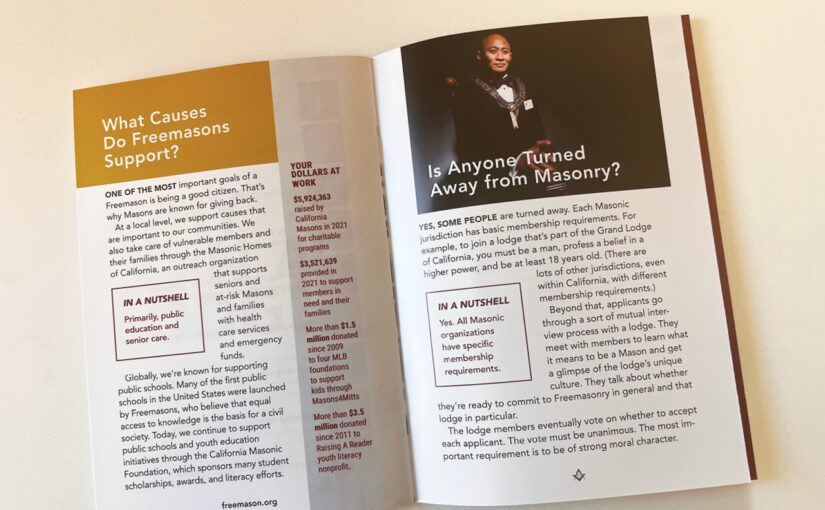
Download the Simple Guide to Freemasonry

How did you first learn about about Freemasonry? Was it by stepping into a lodge hall and meeting with members? At a community event? From a movie or TV show?

PROBABLY NOT!

Research shows that by far, the most common introduction that current members had to the organization came from a personal connection such as a relative or colleague. In other words, not from the Internet. That’s why it’s so important that current members feel comfortable talking about Freemasonry with the people around them—and that those searching for more information are provided with simple and accurate answers.
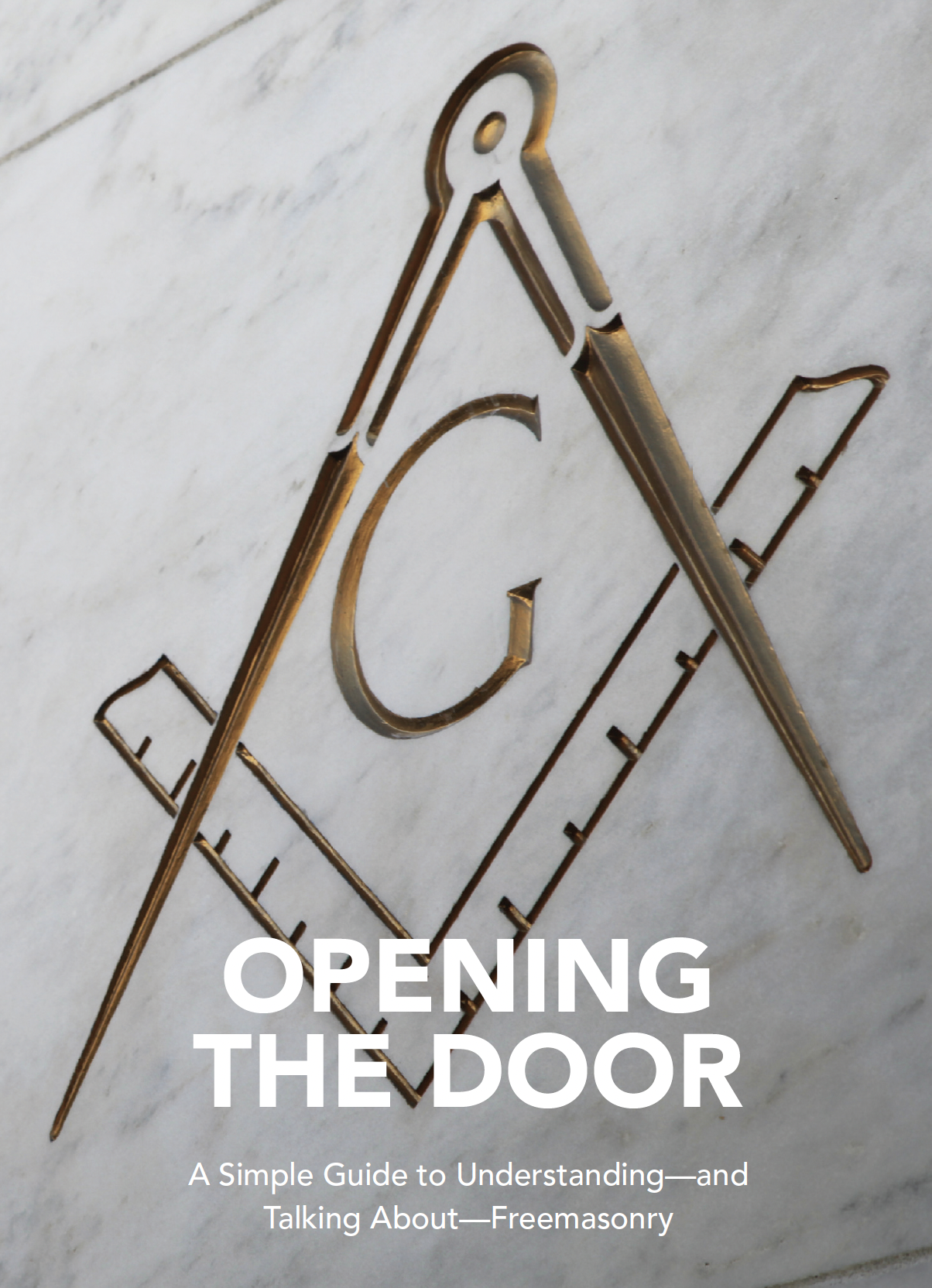
To that end, this short booklet is designed to help current members answer some of the most common—but often confusing—questions about Freemasonry.

Download and read through this guide to brush up on the basics. And share it with those around you who’d like to learn more. Don’t worry about memorizing answers. The most powerful thing you can do is share your personal experience. Consider this a tool to help you get started.

DOWNLOAD THE GUIDE

As members, you’re encouraged to discuss your Masonic experience with people around you. It’s how the tradition stays alive, from one person to the next.
Learn About Freemasonry Symbols

Learn more about Freemasonry at: freemason.org/freemasonry-symbols


An introduction to the symbols, signs, and emblems of Masons and Masonic lodges.

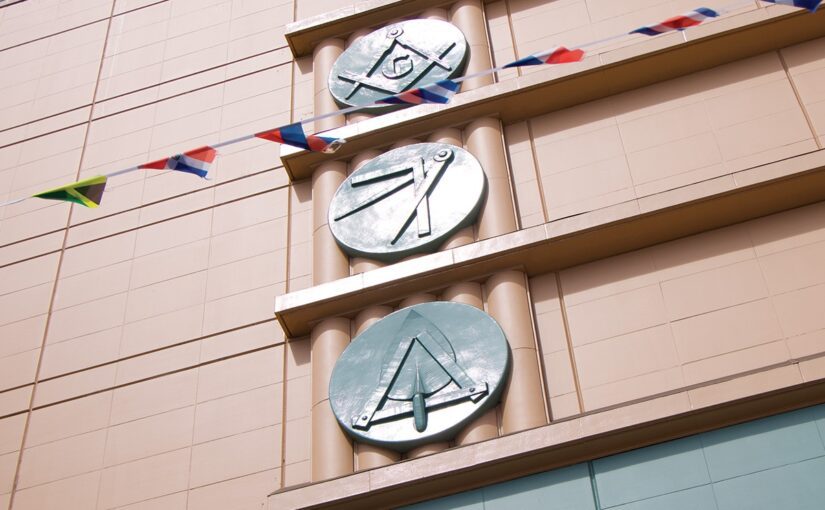
Maybe you’ve heard rumors about the “Freemason pyramid” on the dollar bill, seen the square and compass logo on buildings around town, or wondered about the meaning of emblems like the Masonic trowel. What’s the history behind Masonic symbols, and how do they factor into what happens in a lodge?

Why Does Masonry Use Symbols?

From soaring architecture to dime-sized lapel pins, symbols adorn every part of the Masonic experience. Why? Symbols allow people to communicate quickly, and to transcend language barriers. When you see a green light or a circle with a line through it, you know what it means. Likewise, Masons use metaphors from geometry and the architecture of stonemasonry to inform their continuing pursuit of knowledge, ethics, and leadership skills.

From the Square and Compass to the Letter G: The Meaning of Masonic Emblems

When speculative Masonry began in the 17th century, it adopted the stonemason’s tools as symbols to illustrate life lessons. Freemasonry’s symbols today remain remarkably true to the first stonemasons’ working tools.

Here are some of the best-known Masonic symbols:

  • Apron: Known as the “unique badge of a Mason,” the apron is the most recognizable item of a Mason’s attire. Masons wear aprons while at lodge, and at certain public events. The tradition dates back to the fraternity’s operative days, when stonemasons wore protective work aprons.
  • Square and CompassThe Masonic square and compass is probably the most common symbol in Masonry, used to represent Freemasons and Masonic lodges around the world. Ancient stonemasons used the tools to create 90-degree angles and test the accuracy of their stones. In “speculative” Masonry, the square is an emblem of morality. The compass represents the relationship between the individual and society.
  • The Letter G: The letter G is often seen in the center of the square and compass symbol. It stands for geometry, the basis for stonemasonry—and, symbolically, for modern Freemasonry.
  • Plumb and Level: In stonemasonry, the plumb and level ensure surfaces are vertically and horizontally flush. For today’s Freemasons, the plumb is a symbol of justice, rectitude, and the importance of living in an upright manner, while the level is a reminder that all men are equal. You may have heard the phrase, “To meet on the level and part on the square.” That’s where it comes from!
  • Trowel: One of a stonemason’s most important working tools is the trowel, used to spread mortar that binds stones together. In Freemasonry, the trowel is used to spread the “cement” of brotherly love to unite a sacred band or society of friends.
  • Rough and Perfect Ashlars: The ashlars are two stone cubes placed near the master’s platform in the lodge; one is rough-edged, delivered straight from the quarry; the other is smooth and ready for building. The rough ashlar represents man in his crude form, while the perfect ashlar represents the man, who, through the teachings of Masonry, has become more polished. We never become a perfect ashlar, but we work toward it.
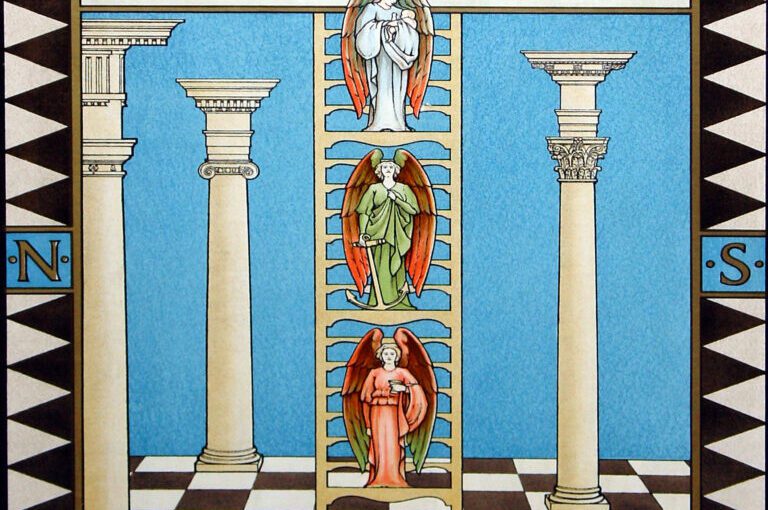
  • Columns: Every Masonic lodge has representations of two pillars, replicas of the two columns that flanked the entrance to King Solomon’s temple. The pillars are said to represent strength and establishment.
  • Winding Staircase: The winding staircase is another symbol inspired by King Solomon’s temple, referring to the steps leading from the entryway to the middle chamber of the temple. It’s an allegory for a member’s progress from Entered Apprentice to Fellow Craft.
  • Other Masonic symbols include: The beehive, the acacia tree, the 47th Problem of Euclid, the Ark of the Covenant, the anchor, cable tow, sheaf of corn, gavel, and blazing star. Here’s a resource explaining some less-well-known Freemasonry symbols.

What’s the “Freemason Pyramid?”

Hollywood blockbusters like National Treasure and bestsellers like Dan Brown’s The Da Vinci Code and The Lost Symbol have done much to sensationalize Freemasonry’s symbols. A lot of the time, they contain more fiction than fact.

Take, for example, the image of the eye and the pyramid on the dollar bill. The pyramid does not appear in regular Masonic ritual or symbolism. The all-seeing eye, sometimes called the eye of providence, is used by Masons to represent the omniscient eye of God. But in the 18th century, when the U.S. was designing its Great Seal, the symbol was common among non-Masonic groups, too.

So what should we make of the rumors that Masons designed the dollar bill, or that the Great Seal of the United States is a Masonic emblem? They’re false, and false. According to Masonic historian S. Brent Morris, the only known Mason on the design committee was Benjamin Franklin, and his ideas didn’t make it into the final design. Artist Pierre Du Simitiere, a non-Mason, contributed the design for the eye. Another non-Mason, Francis Hopkinson, contributed the pyramid.

Explore Masonic landmarks of San Francisco, Past and Present!

California № 1 has met in San Francisco since 1848—but that doesn’t mean it’s stayed put that whole time. In fact, the lodge had at least six different meeting places in just its first half-century.

In our latest online feature, explore historical Masonic landmarks of San Francisco, from the 1860 Grand Lodge Temple at Post and Montgomery to the Moorish Revival Islam Temple, described as an “elaborately eclectic fantasy.”
This is an interactive, time-traveling jaunt through the historic home of California Freemasonry.

Visit: maps.freemason.org/historic-san-francisco

Digging Up the Past at a Masonic Cemetery

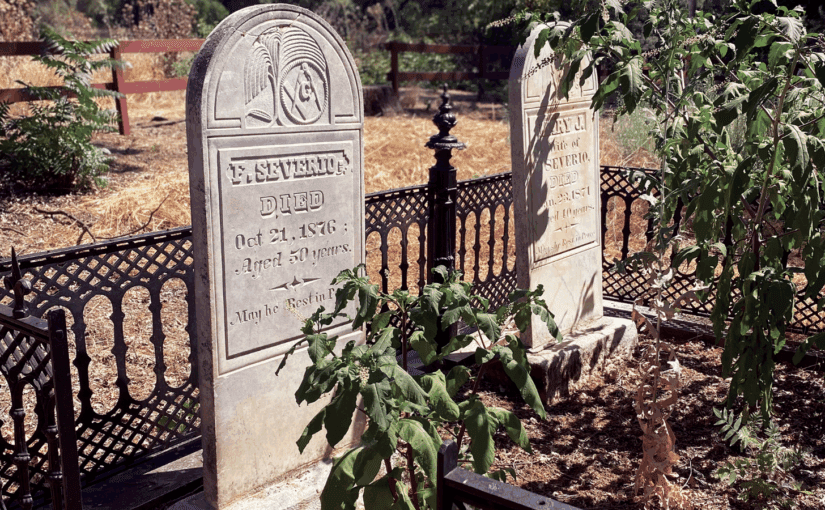
This year, the Grand Lodge of California is working to uncover more local history contained within the small Jamestown Masonic Cemetery. Built in 1854, it served the membership of St. James № 54 until 1875, when the lodge disbanded. Today it’s one of two GoldRush-era cemeteries owned by Grand Lodge, which has set out to clean up and make repairs to the site, and to catalogue all known and unknown remains there.
So far, the effort has included using a canine forensic team to locate unmarked burials, developing boundary and topographical reports, and engaging a team of researchers to dig up the stories behind the burials including the mausoleum of John Pereira, one of Jamestown’s leading figures.
An early miner in the area, he later distinguished himself as an orchard owner, winemaker, and a real estate magnate. He built the Jamestown Hotel, where President McKinley once stayed, and helped establish the Sierra Railway depot, transforming Jamestown from a humble mining camp into a proper little city.